
They Cut His Brain in Two — and He Became "Two People"?
The surgery was a success. Until his left hand started fighting his right.
Pick your format 👇
In the 1960s, a team of American surgeons cut a man’s brain down the middle. He woke up, could talk, could walk, recognized his wife and kids. Everything seemed fine. Then, some time later, something strange began to happen — his left hand would fight with his right.
The first time I heard this story I thought: no way, that’s absurd. But it’s true — and the research behind it went on to win a Nobel Prize.
This is PixelJu, peeling psychology open like an orange. Every week I unpack one classic study that changed psychology. This is the first one in the series, so let’s start with “one head, two people.”
(This is the written version of the video — the video is on YouTube, in Chinese with subtitles.)
1. Why would doctors cut someone’s brain?
To be clear: the surgeons hadn’t lost their minds.
Their patients had an extremely severe form of epilepsy. At its core, epilepsy is abnormal electrical discharge in the brain.
As you probably know, the brain has two hemispheres sitting side by side — left and right, like two office towers. Between the towers runs one very thick skybridge connecting them: the corpus callosum. Picture the walkway between two office buildings, people streaming back and forth — that’s how the two hemispheres share information.

During a seizure, the abnormal discharge storms across that bridge from one tower to the other, and the whole brain convulses — beyond what medication could control. So the doctors tried something radical: cut the bridge. Trap the electrical storm in one hemisphere, spare the other.
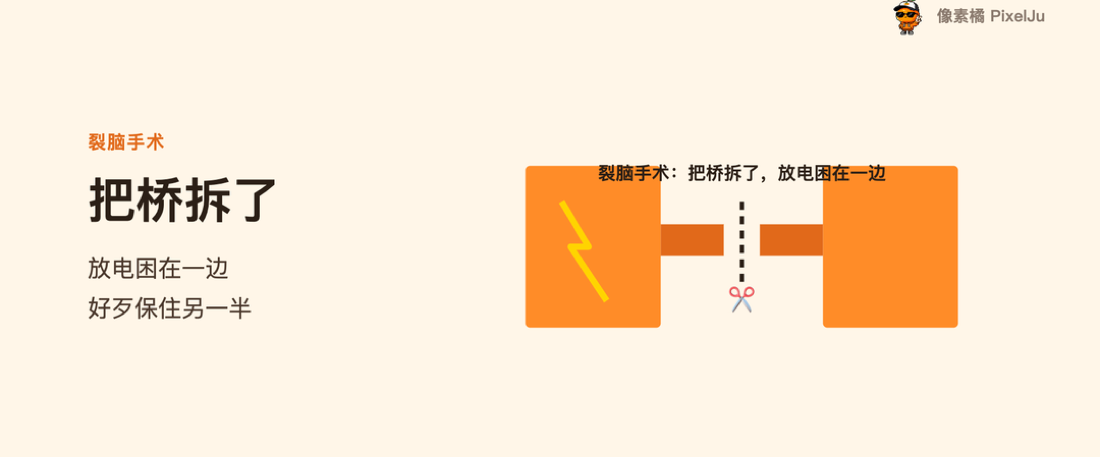
The operation was called “split-brain surgery,” and it genuinely saved lives.
Then a psychologist looked at these patients and a question popped into his head: with the bridge gone, do the two hemispheres still share information? Do they even know what the other is doing?
His name was Roger Sperry. Together with his student Michael Gazzaniga, he designed a set of ingenious experiments to find out.
2. How the experiment worked
One small piece of background first.
Whatever appears in your right visual field is delivered to your left hemisphere; whatever appears in your left visual field goes to the right hemisphere. For most of us this doesn’t matter — the bridge is intact, and both sides sync up within a second. But not for split-brain patients: what the left brain sees, the right brain doesn’t know about, and vice versa.

So the researchers had patients stare at a dot in the center of a screen, then flashed a picture to the left or right side — fast, too fast for the eyes to move.

Scene one. A word flashes on the right — “KEY.” It lands in the left hemisphere. The left hemisphere handles speech, so the patient says: “I saw ‘KEY’.” Normal so far.
Scene two. Same word, but flashed on the left — into the right hemisphere. The right hemisphere isn’t much of a talker. The researcher asks: “What did you see?” The patient says: “What? I didn’t see anything.”
Now the good part. The researcher says: reach your left hand under the cloth and feel around. The left visual field and the left hand are both run by the right hemisphere. And the patient’s left hand, groping through a pile of objects, accurately — pulls out the key.

Picture that: the mouth is saying “I saw nothing,” while the hand has already fetched the object. Because the right hemisphere can’t speak, it couldn’t report the word “KEY” — but it saw it, remembered it, and steered the left hand to retrieve it. Half of this person’s brain knew something the other half didn’t.
Wild, right? I got goosebumps the first time I read this.
Scene three — the famous one. Show the left hemisphere (right visual field) a chicken claw, and simultaneously show the right hemisphere (left visual field) a snow scene. Then ask the patient to pick a matching card with each hand.
The right hand — run by the left brain — picks a chicken. Claw, chicken: makes sense. The left hand — run by the right brain — picks a shovel. Snow, shovel: also makes sense. Both correct.

Then the researcher casually asks: “So… why the shovel?”
Remember: the talking hemisphere is the left one, and it only saw the chicken claw. It has no idea any snow exists.
Without missing a beat, the patient answers: “Oh, the shovel is for cleaning out the chicken shed.”
3. The part I find genuinely unsettling
Sit with that answer for a second.
The left brain had no idea why the left hand chose a shovel. But it did not say “I don’t know.” It invented a reason on the spot — a rather sensible one — and, crucially, it believed its own story.
Gazzaniga later gave this mechanism a name: the “left-brain interpreter.” Its job: whatever happens, hand you an explanation that hangs together. Even if it has to make one up in real time.

And here’s the thing — this is not a split-brain quirk. This is standard equipment. You and I run it every day.
After an impulse buy: “I’ve actually needed this for ages.” Ask a friend what she saw in the ex who treated her badly: “He was really good to me at the beginning.” So many of our reasons are written after the fact, to make what we did feel coherent — that’s the left-brain interpreter on shift.
We like to think we “think it through, then act.” This experiment says: much of the time you act first, and then a dedicated storytelling department files a reason afterward.
4. While we’re here: a myth to bust
You’ve seen those quizzes — “Are you left-brained or right-brained? Left = logical, right = creative.”
That’s basically fiction.
Sperry’s work did reveal a division of labor: the left hemisphere is better at language, logic, step-by-step processing; the right is better at spatial tasks, faces, holistic impressions. But “better at” is not “exclusively responsible for.” In an intact brain, both hemispheres collaborate across the corpus callosum every second of the day. You cannot be a “right-brained person” any more than you can be a “left-legged person” — walking takes both.

The genuinely interesting takeaway isn’t “which type are you.” It’s that there is more than one decision-maker living in your head — you just never feel the seams.
5. What this has to do with you
In my clinical work with insomnia, I often meet people who lie in bed with two voices arguing: one says “sleep NOW, tomorrow is ruined,” the other says “the more you push, the more awake I get.” Then they ask me: is something wrong with me?
No. You are the perfectly normal owner of a brain that argues with itself.
Knowing this study, here’s what I’d actually do with it:
- When you feel torn, contradictory, unable to “make up your mind” — don’t scold yourself. It’s not that you can’t think straight; it’s that several departments in your head genuinely disagree.
- Hold your own explanations a little loosely. Especially the smooth, elegant ones. The smoother the story, the more likely the interpreter improvised it.
- Stop taking left-brain/right-brain tests. Save your money.
One last thing
Sperry received the 1981 Nobel Prize in Physiology or Medicine for this line of research. Late in his life he remarked, in essence: these patients showed us that the “self” may be far less singular than we assume.

Want to feel it firsthand? Play the Split-Brain Challenge and see whether you can respond the way “they” would.
Next up: dogs who were shocked, could escape — and lay down instead. Learned helplessness, the psychology behind giving up.
📎 Study file
- Sperry, R. W. (1968). Hemisphere deconnection and unity in conscious awareness. American Psychologist, 23(10), 723–733.
- Gazzaniga, M. S. (1967). The split brain in man. Scientific American, 217(2), 24–29.
- Nielsen, J. A., et al. (2013). An evaluation of the left-brain vs. right-brain hypothesis. PLoS ONE, 8(8), e71275.
- Hock, R. R. Forty Studies That Changed Psychology, Study 1 "One Brain or Two?"
Every piece on this site cites its primary sources. Popularization simplifies; when in doubt, the original papers win.