
Giving Up Isn't Your Fault — It's the Factory Setting
It could escape. So why did the dog lie down and take the shock? Fifty years later, the man who coined "learned helplessness" tore it down himself.
Pick your format 👇
Quick inventory — how many of these are yours?
- Gym membership, three months old, used twice
- A CV half-edited, saved to drafts, never reopened
- The red dot on the work chat: seen, not touched
- That course you meant to take, progress bar frozen at 12%
- The pile in the corner you walk past every single day
We call this being lazy. On a bad day we call it being useless.
In 1967, a group of dogs proved — in a fairly brutal way — that it isn’t laziness.
(This is the written version of the video — the video is on YouTube, in Chinese with subtitles.)
1. The dog that wouldn’t jump
In a lab at the University of Pennsylvania in 1967, a dog lay on an electrified floor.
The box had a low barrier down the middle. Step over it and the other side was safe — for a dog, about the height of a doorstep. Other dogs, first time in that box, worked it out in seconds.
But this one didn’t jump. It lay there, whimpering, trembling, and took the entire session without moving.
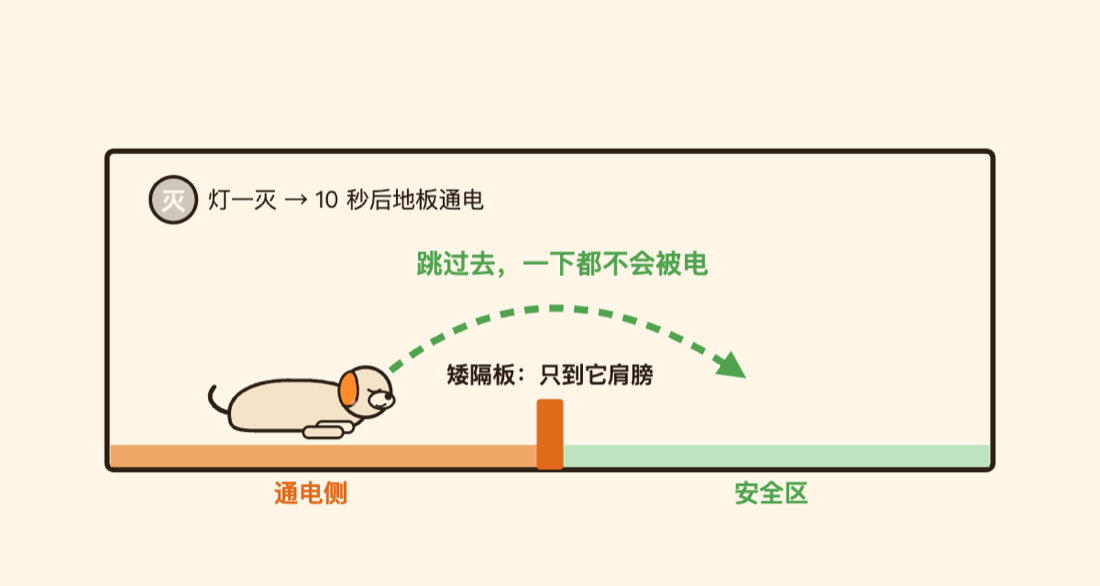
Same box. Same current. Why had it given up?
The man running the experiment was Martin Seligman, then a graduate student at Penn, later president of the American Psychological Association. The study he designed with his colleague Steven Maier rewrote the textbooks — and fifty years later, the two of them rewrote it a second time, themselves.
2. The clever part: the shocks were identical
They took twenty-four dogs and split them into three groups.
Group one could escape: shocked, but with a panel on either side of the head — press it, and the current stopped.
Group two could not. Each dog was paired one-to-one with a dog in group one and received exactly the same shocks — when the first dog switched the current off, it went off for its partner too.
This is called a yoked design, and it’s the soul of the whole experiment. Both groups took identical current, identical timing, identical intensity. The only difference was one word: useful. One group’s actions worked. The other’s didn’t.
Group three was a control and got no shocks in this phase.
The result: group one quickly learned to press the panel. Group two struggled about thirty times, and then simply lay down.
The real test came twenty-four hours later. Every dog went into the shuttle box from the opening scene: the light goes out, ten seconds later the floor goes live, and stepping over the barrier ends it. Ten trials each.
The escape group and the control group figured it out within a few trials. Of the eight dogs in the inescapable group, six never learned to escape at all — ten chances, lying there for every one of them. Tested again a week later, five of those six still lay down.
There’s one detail in the middle that stays with you: one dog happened to make it over the barrier once, and escaped. On the next trial it went back to lying down.
Seligman’s reading: these dogs had learned one thing — nothing I do matters. He named it learned helplessness.
3. This isn’t only about dogs
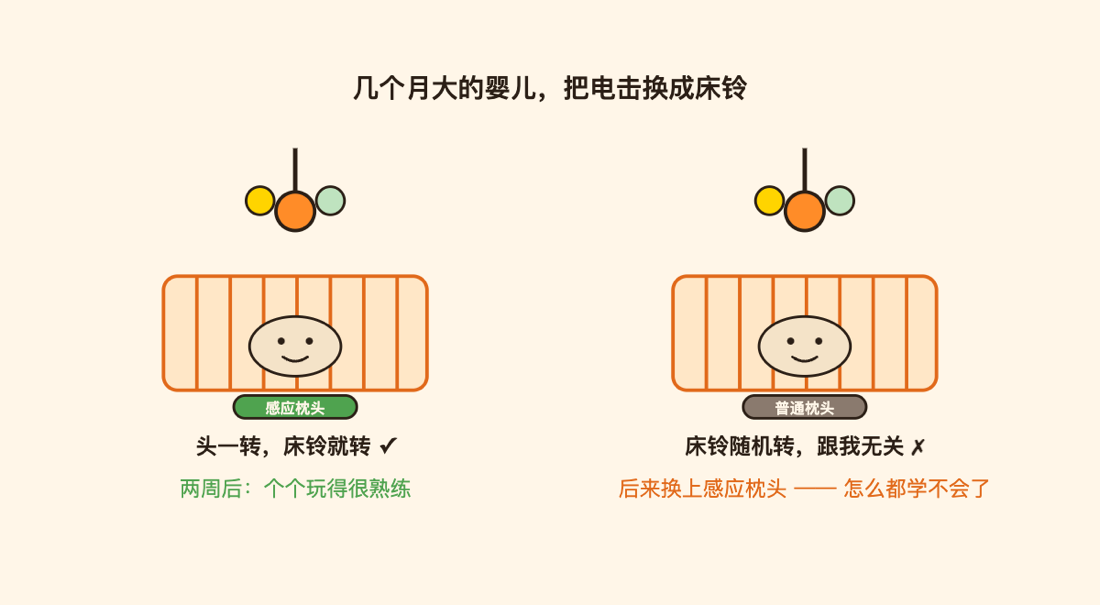
Later researchers found the same pattern in infants a few months old — using, of course, not shocks but a crib mobile.
One group of babies had a pressure-sensing pillow: turn your head, and the mobile above the crib turned too. Two weeks later they were all experts at it. The other group’s mobile turned at random, unrelated to anything they did. When researchers then gave that group the sensing pillow as well, plus extra time to learn — they couldn’t learn it any more (Finkelstein & Ramey, 1977).
Seligman then pointed the same logic at adults: people whose applications vanish into the void, employees whose every effort gets shot down, anyone who tries to change something, again and again, and fails. The “forget it, nothing works anyway” state that many of them end up in runs almost the same script as the dog in the box. He argued this was one source of depression.
Which leads to something that may cut against intuition: that total shutdown isn’t laziness, isn’t a character flaw, isn’t a lack of ambition. It looks much more like a trained outcome — trained by repeated evidence that nothing you do changes anything.
(To be clear: depression has genuinely complex causes — biological, psychological, social. Learned helplessness is one piece of that puzzle, not an equals sign.)
4. The reversal, fifty years on
The theory ran for fifty years and made it into every psychology textbook.
Then, in 2016, Psychological Review published a paper titled “Learned Helplessness at Fifty.” The authors were two people: Maier, and Seligman.
Yes — those two. And in it they said something you almost never read in a scientific journal: we had it backwards.

While writing this piece I learned that Maier died in July 2026, aged 83. Which means one of the major projects of his last decade was correcting his own most famous theory.
Over those fifty years, neuroscience had traced helplessness through the actual circuitry. The conclusion: helplessness doesn’t have to be learned at all.
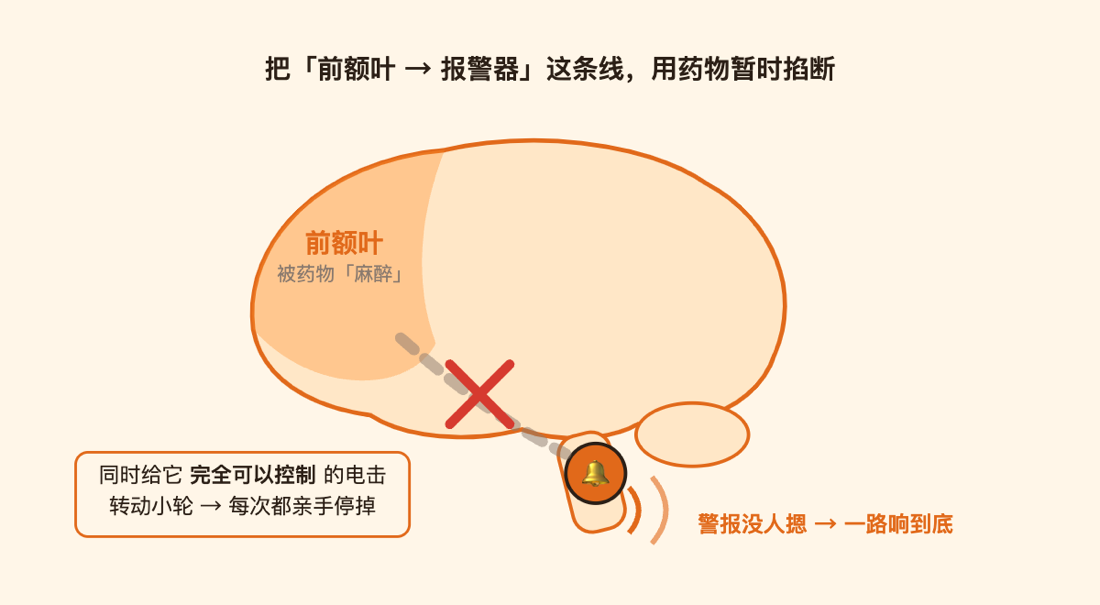
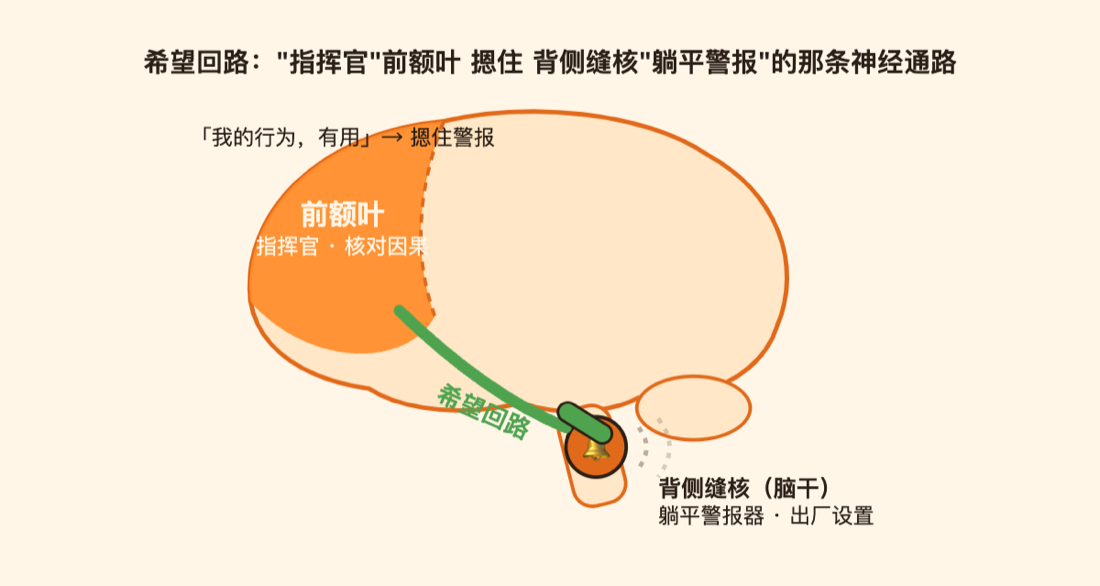
Deep in the brain sits a very old alarm system (the dorsal raphe nucleus). Sustained, inescapable pain sets it off, and the whole body drops into “lie down, stay still, conserve.” That’s the mammalian default — the factory setting. Nobody teaches it to you.
What does have to be learned is the other half. The prefrontal cortex — the ventromedial part — is checking one question: is what I’m doing working? The moment it detects that it is, it suppresses the alarm system. Stand down; we’ve got this one.
That isn’t a nice metaphor, it’s a nailed-down experimental result. The key study (Amat et al., 2005, Nature Neuroscience): researchers temporarily inactivated a rat’s prefrontal cortex with a drug, then gave it shocks it could fully control. On day one the rat looked completely normal — it quickly learned to turn a wheel in the cage and shut off every single shock with its own body. But on day two, placed in a brand-new box, it behaved as though it had never controlled anything in its life: a few struggles, then down it went.
Why? Because while it was successfully stopping the current the whole time, the part responsible for checking cause and effect — and pressing the alarm’s off switch — was offline. Every shock it stopped with its own paws, the brain never logged.
And in reverse (Amat et al., 2008): artificially activate that same pathway, then give a different set of rats shocks they genuinely cannot control — and the next day they don’t shut down.
Together the two experiments point at the single most important line in the 2016 paper: the brain has no detector for “this isn’t working.” It only has a detector for “this is working.” When that detector is on, the alarm gets held down. When it’s off, the alarm rings all the way through.
Maier and Seligman gave that prefrontal-to-alarm pathway a rather beautiful name: the hope circuit.
There’s also a clue that sat buried for fifty years. The original 1967 paper contained a rarely-mentioned second experiment: dogs who first learned that a jump ended the shock, and were only afterwards exposed to shocks nothing could stop, didn’t shut down either. They called it immunization. In today’s language: a brain that has already learned “this works” comes with its hope circuit pre-charged.
So looking back, the dogs that didn’t give up weren’t tougher. They’d banked a day’s worth of evidence that pressing the panel stopped the current. What they’d learned wasn’t resilience. It was usefulness.
One line for the whole reversal: giving up is the default; control is what you learn.
The first time I read that paper, it struck me as maybe the gentlest self-correction psychology has ever made. Because it means that when you’re stuck inside “nothing I do matters,” you aren’t broken — that’s just the factory setting running. And a sense of control is a skill. Skills can be trained back.
5. So how do you train it
Three small things.
First, stop calling yourself lazy. Every time you say “what is wrong with me,” you’re adding another entry to the ledger marked nothing works — which only makes the alarm ring louder.
Second, start with control so small it feels silly. A sense of control doesn’t come from big wins. It comes from the causal link “I did something, and something changed” being confirmed over and over. Clear one desk. Finish one thirty-minute walk. Pay off one small bill. Don’t dismiss it for being small — to the brain, evidence is evidence.
Third, some traps are the environment, not the mindset. A systematically exploitative job, a relationship that runs on putting you down — no amount of “training your sense of control” fixes those. You have to get out of the box first. And please don’t take this article to anyone still being shocked and tell them to cheer up.
6. The other side of the experiment
One thing has to be said plainly: this experiment caused real suffering to real dogs. Under today’s animal research ethics it would not clear review. The author of the original textbook leaves the question with every reader: dozens of dogs in pain, in exchange for a theory that has helped an enormous number of people. Was it worth it?
I’m not going to answer that for you. Come argue about it in the Bilibili comments.
Want to feel it firsthand? Try the Timed Anagram Challenge — it’s the classroom version of this experiment: two groups get different warm-up puzzles, then an identical official round. You’ve read this far, so you know where the trick is, and your score won’t be counted in the site-wide comparison. If you want someone else to run it blind, send them the plain /en/lab/anagram/ link instead.
A word about sleep
Writing this, I kept thinking about the most common helplessness I see in clinic: not being able to sleep.
Lie down, roll over, check the clock, calculate how many hours are left, get more awake with every calculation. People spend years on this, and land on the same sentence: nothing works. But insomnia is one of the most convincing examples of control being trainable — there’s a guideline-recommended, non-drug approach to it, and its core components are things you can run yourself.
The first step is smaller than you’d expect: write down honestly what time you got into bed last night, when you fell asleep, when you woke — and work out your sleep efficiency. The sleep efficiency calculator on this site does exactly that. It runs in your browser, stores nothing, needs no account.
(This is health education material. It is not medical advice and does not replace seeing a professional. If “nothing I do matters” has been running for more than two weeks and is dragging your sleep, eating, work or study with it, talk to a psychiatrist or a therapist — booking the appointment is itself one rep of “my actions do something.” Crisis lines are on the help page.)
Next up: raise rats in a mansion and their brains really do grow differently — but does “enriched” build a bigger brain, or does deprivation shrink one?
📎 Study file
- Seligman, M. E. P., & Maier, S. F. (1967). Failure to escape traumatic shock. Journal of Experimental Psychology, 74(1), 1–9.
- Maier, S. F., & Seligman, M. E. P. (2016). Learned helplessness at fifty: Insights from neuroscience. Psychological Review, 123(4), 349–367.
- Amat, J., et al. (2005). Medial prefrontal cortex determines how stressor controllability affects behavior and dorsal raphe nucleus. Nature Neuroscience, 8(3), 365–371.
- Finkelstein, N. W., & Ramey, C. T. (1977). Learning to control the environment in infancy. Child Development, 48(3), 806–819.
- Hock, R. R. Forty Studies That Changed Psychology, Study 31 "Learning to Be Depressed."
Every piece on this site cites its primary sources. Popularization simplifies; when in doubt, the original papers win.