
The Rats in the Mansion Paid Sixty Years of Your "Smart Baby" Tax
Rats raised in a "mansion" lost to rats living in a field. Early-education ads have run on this experiment for sixty years — and they never tell you the second half.
Pick your format 👇
You’ve probably seen all of these:
- “Ages 0–3 are the golden window for brain development — miss it and it’s gone”
- “The richer the stimulation, the smarter the baby”
- “Whole-brain development: unlock the right hemisphere”
- “Prenatal education starts with Mozart”
- And the version sold to adults: “After thirty, the brain is set”
The first four reach for a parent’s wallet. The last one pours cold water on grown-ups.
All five trace back to one lab, and one batch of rats.
Today I’ll tell that experiment from the start — including the second half the ads never mention. By the end you’ll see that the first four lines take a real finding and water it down for sale, and the last one gets it exactly backwards.
(This is the written version of the video — the video is on YouTube, in Chinese with subtitles.)
1. Three brothers from one litter, three different fates
In the early 1960s, Berkeley had an unusual research group. Its three core members came from three disciplines: the psychologist Mark Rosenzweig, the chemist Edward Bennett, and the anatomist Marian Diamond.
They wanted to answer a question almost nobody dared touch at the time: can experience change the brain’s hardware?
Seeing changes inside a brain meant dissecting it, so humans were out. They used rats. The design was careful: from each litter they took three males — brothers, near-identical genes — and assigned them at random to three kinds of cage.
The standard cage. A few rats together, food and water. Think ordinary dorm.
The impoverished cage. One rat alone. Same food and water, but no company and nothing to play with. A single room.
The enriched cage. A dozen or so rats in one big cage with wheels, ladders, all kinds of toys — the researchers kept 25 different toys and rotated in a fresh combination every day. They joked it was practically a rat Disneyland.
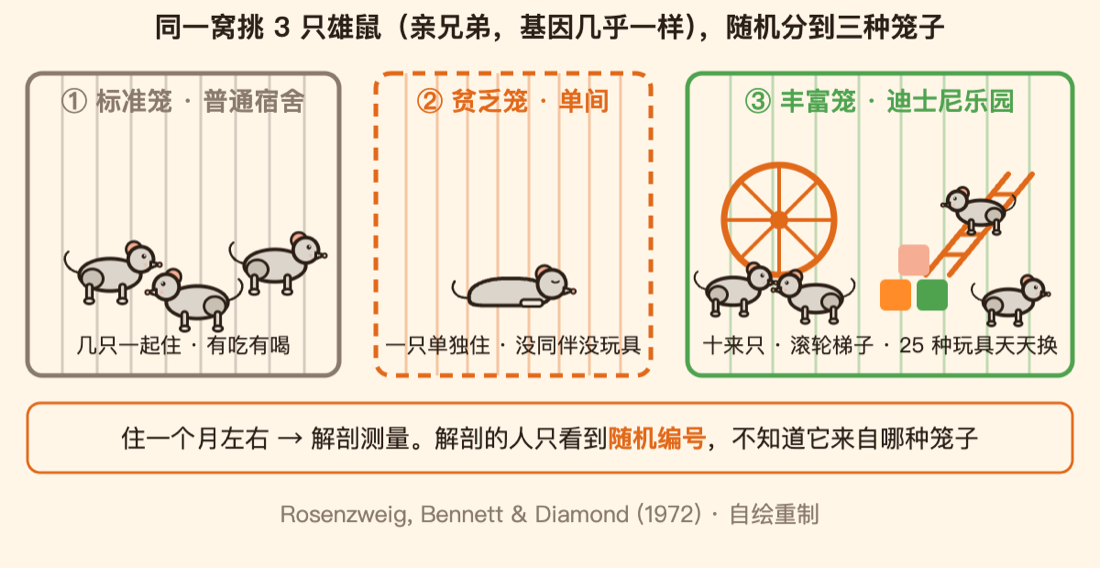
After about a month, the rats were dissected and their brains measured.
One detail I want to point out. To stop “expecting something and therefore finding it,” every rat was given a random number before dissection — the person at the bench had no idea which cage it came from. That wasn’t fussiness: in the same decade another psychologist showed that simply telling students “your rats are the smart ones” made those rats score better. We’ll get to that story in Study 13.
2. “Young lady, the brain cannot change!”
The dissections showed three main differences between the “Disneyland” rats and the “single room” rats:
A heavier, thicker cerebral cortex — by how much? About 6 percent on average. Over ten years the team ran the experiment sixteen times, and the difference showed up every time.
Higher total activity of an enzyme called acetylcholinesterase. Neurons signal each other with chemicals; once a signal has passed, a “cleaner” has to clear those chemicals quickly so the next one can get through. This enzyme is the cleaner, and when it’s busier the whole signalling system is usually running harder.
Under the electron microscope, the synapses — the contact points between neurons — were on average 50 percent larger.
Behind those three results sat a more important one: the cortex got heavier and thicker not because there were more neurons, but because the neurons themselves and their synapses had grown. One other cell type did increase, by 14 percent — the glial cells, which you can think of as the neurons’ logistics corps: hauling nutrients, wrapping insulation, clearing waste.
In other words, enrichment didn’t add rooms to the brain. It renovated the house that was already there.

Today we call this “neuroplasticity,” and the word has been worn smooth. Back then, it was heresy.
1964, the annual meeting of American anatomists. Diamond presented the finding in public for the first time. When she finished, a man in the back row stood up and shouted: “Young lady, that brain cannot change!”
Because in that era, “the brain you’re born with is the brain you die with” was the settled view of the whole field.
Diamond’s answer: “I’m sorry, sir. But we have the initial experiment and the replication, and they both show that the brain can change.”
3. They didn’t hold a press conference. They ran three controls
Facing a room full of doubt, what this team did is, to me, a model of what good science looks like: take every rival explanation and knock it out with an experiment.
“Could it be the handling?” Toys were swapped daily in the enriched cage, so those rats were picked up twice a day. So they ran a control: one group handled every day, one never — no brain difference. Later they simply handled every group every day, and the difference between cages still appeared.
“Could the stress of solitary living be shrinking the brain?” They took a separate batch of rats and put them through a standard stress routine each day: a slowly rotating drum, or mild shocks. These rats were genuinely stressed — at dissection their adrenal glands, which pump out stress hormones, had grown heavier, the way a gland does when it works overtime for weeks. Their brains, compared with unstressed rats, hadn’t changed at all.
“The biggest cortical difference is in the visual area — maybe the enriched rats just had more to look at?” They reran the experiment with blind rats, then again with rats raised in total darkness. The difference still appeared.
Three objections, three controls. That is how “experience can change the brain” came to stand.
4. Reversal one: the rats in the field
So far this sounds like the scientific version of “a rich upbringing builds a good brain.” Advertisers certainly used it that way.
But this group of scientists took one more step themselves — and that step turned the whole story over.
They realised the lab rats had been breeding in cages for more than a hundred generations. We called the standard cage “normal” and the toy cage “enriched,” but that coordinate system had the cage as its origin. For a rat, what is actually normal?
The outdoors.
So at Berkeley’s field station they built open-air enclosures with soil and logs, and moved lab rats in for a month. One detail that moved me: these rats, caged since birth, started digging burrows the moment they got outside — after a hundred-plus generations that had never dug, with nobody to teach them.
Then the result: eight experiments, and eight times the outdoor group’s brain development beat the brothers left in the indoor “Disneyland.” Eight to nothing.
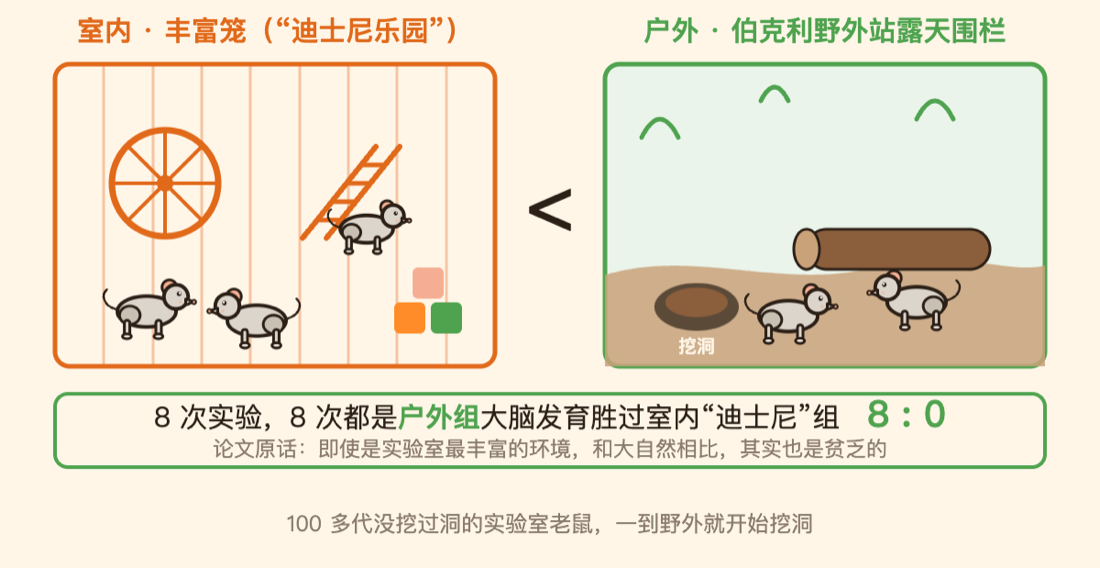
The researchers wrote a sentence in the paper that I’d render as: even the most enriched laboratory environment is impoverished compared with nature.
Once that’s on the table, the earlier conclusion has to be read the other way round. It isn’t “an enriched environment makes the brain bigger.” It’s “an impoverished environment makes the brain shrink.” The so-called enriched cage was merely less impoverished.
And there are far too many people selling the first half only.
The classic case is the “Mozart effect.” It went round the world in the nineties: listen to Mozart and get smarter. In 1998 the governor of Georgia took it seriously and arranged for every newborn in the state to receive a classical music CD.
I went back to the 1993 source paper. The participants were 36 university students. They listened to ten minutes of piano music; what improved was one spatial paper-folding test, and the effect lasted about a quarter of an hour. Not one baby was studied, start to finish. The lead author, Frances Rauscher, later came out and said so herself: my research does not support “listening to Mozart makes children smarter.” In 2010 a meta-analysis of thirty-odd years of work carried a viciously good title — Mozart effect–Shmozart effect — and concluded the effect is small enough to ignore.
Premium early education runs on the same recipe: swap “deprivation is harmful” for “more is beneficial.”
Yet Rosenzweig and colleagues had thrown cold water on that in the original 1972 paper: the learning gains from enriched experience tend to be short-lived and task-specific, and nobody should expect it to raise “general ability.” They even cited Harlow’s monkey work as a warning — intensive training started too early can lock a young monkey into immature patterns of behaviour.
So for a baby, what is an enriched environment? Someone who talks to them, someone who plays with them, things to grab, to look at, to put in their mouth. An ordinary home where somebody loves you is already an enriched environment.
A baby’s real impoverished cage is being left alone for long stretches — nobody holding them, nobody talking to them. It has nothing to do with which classes you signed up for.
5. Reversal two: no age limit — and no free lunch
Now the line aimed at adults: “After thirty, the brain is set.”
On the same line of research it later turned out that one-year-old rats — roughly human middle age — put into an enriched cage showed the same cortical thickening, just more slowly. In 1997 Nature pushed further: adult mice in enriched housing grew new neurons in the hippocampus, the memory region — 15 percent more. The old rule “neuron count doesn’t change” was broken, at least in that region.
And people? The MRI era answered.
London taxi drivers have to memorise more than twenty thousand streets to earn their licence. In 2000 scientists scanned their brains: the rear part of the hippocampus was clearly larger, and the longer they’d been driving, the larger it was. The 2011 follow-up was stricter: 79 trainees, 39 of whom passed after four years — and only the ones who passed had a bigger hippocampus. Training grew the brain; it wasn’t that people with bigger brains chose to drive.
But here’s a detail you will never see in an ad, and I want to say it carefully: in the same drivers, the front part of the hippocampus was smaller than in controls.
The brain doesn’t hand you a free block of new memory. It’s more like reallocating within a fixed budget: expand here, and the bill may be paid elsewhere. Plasticity is neutral. It doesn’t ask about direction — whatever you practise daily it strengthens, whatever you leave idle it reclaims. That’s also why, in the juggling experiment, ordinary people who learned to keep three balls in the air for three months gained grey matter in the region that tracks moving objects — and after three months without practice, it shrank back part of the way.
Train it and it grows; stop and it recedes. There is no “pay once, valid for life.”

The best part: the three authors predicted the human answer themselves. At the end of the 1972 paper they posed a question they couldn’t test — would musicians, as a group, have a more developed auditory cortex? Thirty-one years later, in 2003, MRI replied: yes. Professional musicians beat amateurs, amateurs beat non-musicians, step by step, clear as day.
6. Einstein in a mayonnaise jar
The person I most want to linger on this episode is Diamond.
In 1984 she received a parcel in the mail. She had spent three years applying for it. Inside were four slices of brain preserved in formalin — packed in a mayonnaise jar.
It was Einstein’s brain.
She counted and recounted under the microscope, and found that the physicist’s brain also had a higher proportion of glial cells — the same “logistics corps” from the rat experiment. From Berkeley’s rats to Einstein in a mayonnaise jar, she had chased one kind of cell for twenty years.
And she may be the best living proof of lifelong plasticity herself. She taught human anatomy at Berkeley for more than fifty years, always carrying a flowered hatbox to class with a real human brain inside. She retired at nearly ninety. Asked for her secret, she said curiosity — because nerve cells live on stimulation.
The “young lady” shouted at in 1964 spent the next half-century making her reply stick.
7. Back to us: three things for “changing cages”
Go back to the experiment and the recipe for “enrichment” is sitting right there. A group of rats with no toys: doesn’t work. One rat facing a pile of toys: doesn’t work either — it doesn’t play, it just sits there. What works is three things together:
Company. Novelty. Hands-on tinkering.
Translated to humans: spend time with people, touch new things, do them yourself. My own reading is that spectating doesn’t count — scrolling through someone else’s round-the-world trip is a bit like watching another rat’s toys through the bars.
The threshold is lower than you’d think. The paper has a number: two hours a day of enrichment gets you close to the round-the-clock effect. So nobody needs to quit their job and travel the world. A dish you’ve never cooked, a road you’ve never walked, a craft you’ve kept at for three months — to the brain, that’s a new toy.
Finally, and this is the part I most want to stress: some impoverished cages are real, not a matter of attitude. The patient confined to bed for months. The isolated elderly. People stuck in extremely monotonous conditions. For them, the first job is changing the environment itself, even a little: a window that looks onto a street, a fixed daily phone call, one small thing they get to decide. Please don’t take this article to anyone still stuck in a cage and tell them they aren’t trying hard enough.
8. The other side of the experiment
The cost has to be stated. This episode’s rats weren’t shocked, but their story ended on the dissection table. And there’s a quieter layer: we now know that the impoverished cage was itself a harm.
Today’s EU regulations on laboratory animals require that all animals be given environmental enrichment, and that social species be housed in groups. In other words, what the experimental group got back then is today’s legal minimum — and the deprived group, by today’s rules, would not be allowed.
Science corrected not only its conclusion but its own conduct. That’s probably the best account anyone can give to those rats.
What did you add to your brain this month — something new you learned, somewhere you went for the first time, something you did for the first time? Tell me in the YouTube comments.
Next up, Study 3 in the book: if experience can change the brain, how much of a person is shaped by environment in the first place? Scientists tracked down identical twins separated at birth and raised apart, to see how much still matched when they met decades later. This episode asked whether intelligence can be “raised.” Next time: what’s written in the genes and hard to raise at all.
A word about sleep
Writing this, I kept thinking: a lot of people aren’t unwilling to add new things to their lives — they feel they have no energy for it. After work there’s only enough left to lie down and scroll. And the foundation of energy is usually sleep.
If you’re being worn down by not sleeping, the first step is smaller than you’d expect: write down honestly when you got into bed last night, when you fell asleep, when you woke — and work out your sleep efficiency. The sleep efficiency calculator on this site does exactly that. It runs in your browser, stores nothing, needs no account.
(This is health education material. It is not medical advice and does not replace seeing a professional. Crisis lines are on the help page.)
📎 Study file
- Rosenzweig, M.R., Bennett, E.L., & Diamond, M.C. (1972). Brain changes in response to experience. Scientific American, 226(2), 22–29.
- Bennett, E.L., Diamond, M.C., Krech, D., & Rosenzweig, M.R. (1964). Chemical and anatomical plasticity of brain. Science, 146, 610–619.
- Kempermann, G., Kuhn, H.G., & Gage, F.H. (1997). More hippocampal neurons in adult mice living in an enriched environment. Nature, 386, 493–495.
- Maguire, E.A., et al. (2000). Navigation-related structural change in the hippocampi of taxi drivers. PNAS, 97(8), 4398–4403.
- Woollett, K., & Maguire, E.A. (2011). Acquiring "the Knowledge" of London's layout drives structural brain changes. Current Biology, 21, 2109–2114.
- Draganski, B., et al. (2004). Changes in grey matter induced by training. Nature, 427, 311–312.
- Gaser, C., & Schlaug, G. (2003). Brain structures differ between musicians and non-musicians. Journal of Neuroscience, 23(27), 9240–9245.
- Rauscher, F.H., Shaw, G.L., & Ky, K.N. (1993). Music and spatial task performance. Nature, 365, 611.
- Pietschnig, J., Voracek, M., & Formann, A.K. (2010). Mozart effect–Shmozart effect: A meta-analysis. Intelligence, 38, 314–323.
- Diamond, M.C., et al. (1985). On the brain of a scientist: Albert Einstein. Experimental Neurology, 88, 198–204.
- Hock, R. R. Forty Studies That Changed Psychology, Study 2 "More Experience = Bigger Brain?"
Every piece on this site cites its primary sources. Popularization simplifies; when in doubt, the original papers win.